
Together with the International Centre for Integrated Mountain Development (ICIMOD), we launched the second round of the Hindu Kush Himalaya (HKH) Innovation Challenge for Entrepreneurs (HKH-ICE 2.0) to accelerate locally led, market-ready innovations that strengthen climate resilience across the Hindu Kush Himalaya region. Innovators from Bhutan, Bangladesh (Chittagong Hill Tracts only), India (Indian Himalayan Region), and Nepal submitted creative, locally-rooted climate innovations. After rigorous review, the team selected 21 finalists who received tailored mentoring for five weeks to further develop their solutions.
We’re pleased to announce the 12 winners. The winners will continue to receive tailored mentoring including leadership development, communications, MEL, and resource mobilisation support. Additionally, they will receive prizes ranging from USD $5,000 to $25,000 to further develop and scale their solutions.
HKH-ICE is an initiative under ICIMOD’s Himalayan Resilience Enabling Action Programme (HI-REAP) funded through the UK International Development’s flagship Climate Action for a Resilient Asia (CARA) programme.
Meet the winners:
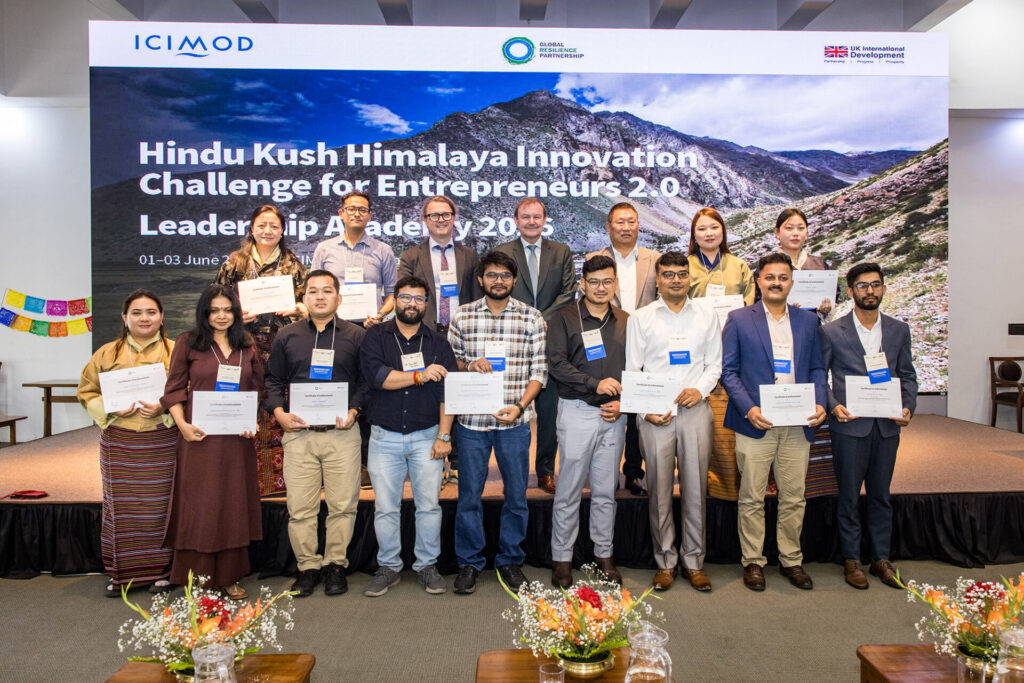
Jitendra Bajracharya / ICIMOD
Organisation: Hillsbazar, Bangladesh
Project title: Resilient indigenous crops: scaling sustainable high-value climate snacks
Hillsbazar is a grassroots innovation transforming Chittagong Hill Tracts’ bioeconomy by supporting 600 Indigenous farmers and 200 micro-entrepreneurs to convert locally grown jackfruit and bananas into high-value, shelf-stable products using solar processing.
Organisation: Bhutan Growers
Project title: Regenerative mountain foods for resilient livelihoods
Bhutan Growers is a women-led enterprise that partners with mountain farming communities to produce traceable, sustainably made cold-pressed oils, natural spreads, and chilli products using indigenous crops grown through nature-based practices.
Organisation: YiGa Chocolate, Bhutan
Project title: Adaptive mountain value chains for diverse small harvests
This project transforms small, non-uniform harvests from Bhutanese farmers into premium chocolate protein bars and trail snacks, creating market value for locally grown crops that often fail to meet commercial standards. By linking tourism with local craft foods, the initiative boosts women and youth incomes, reduces food waste, and supports biodiversity conservation through continued cultivation of diverse crops.
Organisation: Shaoulee Food Products, Bhutan
Project title: Reviving indigenous crops of Bhutan
Shaoulee food products is reviving Bhutan’s indigenous climate-resilient crops by bringing abandoned farmland back into cultivation and supporting farmers through aggregation and value-added processing. The initiative helps strengthen rural incomes, food security, and climate-resilience while addressing rising farmland abandonment and migration in eastern Bhutan.
Organisation: Yoering-Ma, Bhutan
Project title: Yoering-Ma
Yoering-Ma is a youth- and women-led, for-profit Bhutanese enterprise transforming urban food waste into high-quality vermicompost for climate-resilient agriculture. Supplying farmers, institutions, and urban growers, Yoering-Ma strengthens soil health, water retention, and farm productivity while creating green jobs for youth and women.
Organisation: Agrinet Foods and Beverages Private Limited, India
Project title: Project Fragrant Chamoli
Project Fragrant Chamoli restores degraded land in Uttarakhand by removing invasive Lantana weeds and replacing them with high-value aromatic crops such as lemongrass and rosemary. The initiative creates rural jobs, especially for women, boosts farmer incomes through buyback agreements.
Organisation: October Pumpkin-shi Private Limited, India
Project title: Climate-resilient artisan candles in Longpi pottery
October Pumpkin-shi Private Limited supports Indigenous Tangkhul Naga artisans from Ukhrul, Manipur, northeast India by producing artisan candles using traditional Longpi pottery and locally sourced soy wax. The women and youth-led enterprise strengthen climate-resilient livelihoods, increases artisan incomes, and promotes cultural preservation through low-carbon production.
Organisation: Hawaiadda Aerial Innovations Private Limited, India
Project title: Agri-Shield: decision-support tool for climate-resilient agriculture planning
Agri-Shield is a digital Web-Geographic Information System (GIS) platform that helps communities and local governments prepare for climate risks such as landslides and glacial lake outburst floods (GLOFs). The tool supports climate-resilient agriculture planning, protects food supply chains, and strengthens farm-to-market connectivity in mountain regions.
Organisation: PlantSat by Seed Innovations Private Limited, Nepal
Project title: Weather-based parametric mango heat stress insurance
This project will pilot a parametric heat-stress insurance product tailored to mango cultivation and aims to support thousands of smallholder farmers with a focus on women and youth and strengthen resilience through scalable climate risk financing.
Organisation: Swodeshi Innovation, Nepal
Project title: Internet of things-based digital automation system paired with rent-to-own financing (IBDA-RTO)
Across Nepal’s mountains, 75% of drinking water systems sit idle despite years of investment. Manual operations, soaring electricity costs, and chronic equipment failures leave communities-particularly women and youth-without reliable access to safe water. Swodeshi Innovation has developed a smart digital automation system that helps restore failing drinking water lift systems in Nepal’s mountains by making them energy-efficient, climate-resilient, and easier to manage remotely.
Organisation: Forest Plus Private Limited, Nepal
Project title: Adding value to turmeric from restored forests
Forest Plus works with community forests in Jalthal forest, Jhapa district, eastern Nepal to restore degraded areas through agroforestry and organic turmeric cultivation. By improving production standards, branding, and market access, the project links forest restoration with sustainable livelihoods and income generation for local communities, especially women.
Organisation: Aloi, Nepal
Project title: Unlocking climate finance for smallholder dairy farmers
Aloi uses a digital finance platform to help smallholder dairy farmers in Nepal access affordable loans through cooperatives and milk production data. The model reduces lending risks, supports resilient rural dairy markets, and helps farmers invest in sustainable livelihoods while reducing dependence on imported dairy products.